Florida Homeowner
Hurricane prep checklist for South Florida homes
A handyman's timeline for hurricane season in Broward, Palm Beach and north Miami-Dade: what to service in April and May, what to do 72 hours out, and what to check after.
Hurricane season runs June 1 to November 30. Most of the calls I get in South Florida during that window are not emergencies — they are jobs that were easy in April and became urgent in August. A shutter track that will not slide, a garage door with nowhere to attach the brace, a soffit panel that has been rattling since last year.
The useful way to think about storm prep is as a maintenance schedule, not a shopping list. Here is what to do and when.
Why April and May are the whole ballgame
Hardware fails quietly. A shutter you last closed two seasons ago is a shutter you have no information about. Salt air near the coast eats fasteners, aluminum oxidizes into a chalky white powder that binds moving parts, and the tropical humidity gets into every thread on the outside of the house.
None of that announces itself. It announces itself when you are up a ladder with a storm two days out, trying to force a wing nut that has fused to its stud.
So the pre-season job is simple: touch every piece of storm hardware you own, make it move, and fix what does not. Do that in spring and the day-of routine becomes lifting and latching.
The pre-season list
Accordion and roll-down shutters
- Run each shutter through its full travel, all the way closed and all the way open. Do it slowly. You are listening for grinding and feeling for the point where it binds.
- Clean the tracks before you lubricate them. Sand, salt and dead bugs collect in the bottom track. A vacuum with a crevice tool, then a rag, then a dry brush. Lubricating over grit just makes grinding paste.
- Lubricate with a dry PTFE or silicone spray, not a general-purpose penetrating oil. Penetrating oils are water displacers — they free a stuck part but evaporate off and leave the surface bare, and worse, wet oil holds the sand you just removed. A dry film lubricant is what these tracks want.
- Check the wheels and carriers on accordion units. A shutter that drags at one end usually has a wheel that has flat-spotted or a carrier that has come off its track.
- Put a wrench on the mounting hardware. The angle or track is bolted to block or to a header. Fasteners back out over time and corrode where dissimilar metals meet.
- Test the locking pins and the center latch. They are the part everybody forgets, and a shutter that closes but does not lock is not doing its job.
Removable panels
Corrugated aluminum and clear polycarbonate panels live in the garage all year and get treated badly.
- Lay them out and count them against the openings. Panels should be labeled to the window they fit. If they are not, this is the weekend to do it with a paint marker.
- Check every stud and wing nut. The studs threaded into the wall are the failure point — they corrode, they get cross-threaded, and they get snapped off by somebody forcing a panel. Replace missing or damaged ones with matching hardware from the shutter supplier, not whatever is in the fastener drawer.
- Run a nut down every stud by hand. If it does not spin freely, chase the thread or replace the stud now.
- Look at the panel edges. Bent flanges will not seat, and a panel that does not seat cannot transfer load to the wall.
- Keep a labeled bin of spare wing nuts and washers. You will lose some in the grass. Everybody does.
The garage door
The garage door is usually the biggest opening in the house, and it matters more than most people realize: if it fails, wind enters the building and pushes on the roof and walls from the inside as well as the outside.
Check the door for a manufacturer’s label showing a wind rating or Florida Product Approval. If it has one and the door is intact, you are in reasonable shape. If it does not, a bracing kit may be an option — but only a kit approved for that specific door, installed to its instructions. Universal-looking braces bolted into whatever is handy are not an upgrade.
Broward County is inside the High-Velocity Hurricane Zone under the Florida Building Code, which sets stricter product approval requirements than most of the state. Palm Beach County sits outside the HVHZ but still has serious wind load requirements. Either way, opening protection and garage doors are permitted work in most jurisdictions — that is a licensed contractor’s job, not a Saturday project.
Soffit, fascia and the roofline
Soffit is quietly one of the most important things on your house during a storm. It is the vented panel under the eave, and when wind gets under the edge of the roof it tries to push those panels up and in. Once soffit blows out, wind-driven rain goes straight into the attic even if every shingle and tile stays put.
Walk the perimeter and look up. You want:
- No panels sagging, bowed or already popped out of the J-channel
- No gaps at corners where two runs meet
- Fascia board solid, with no soft spots or rust weeping from nail heads
- Drip edge attached along its whole length
Loose fascia and hanging soffit are ordinary handyman repairs in May. In September they are a roofer’s emergency.
Trees near the roofline
Anything overhanging the roof, the service drop or the pool cage is worth dealing with early. Cut back limbs that touch or nearly touch the roof, and clear dead wood — dead limbs come off first and travel furthest. Large removals and anything near power lines belong with a licensed tree service or FPL, not you with a pole saw.
Trimming also has a season. Many South Florida municipalities and associations restrict tree work once a storm is named, and the yard waste pickup schedule fills up fast. Piles of cut branches sitting at the curb when a storm arrives are just ammunition.
Gutters, downspouts and water
Rain volume in a tropical system is not like normal rain. Clear the gutters, flush the downspouts with a hose, and confirm water is actually discharging away from the slab rather than pooling against it. Re-secure loose gutter hangers — a gutter that comes off in wind takes fascia with it.
Everything else bolted to the outside
This is the part homeowners skip and it is genuinely the handyman’s lane:
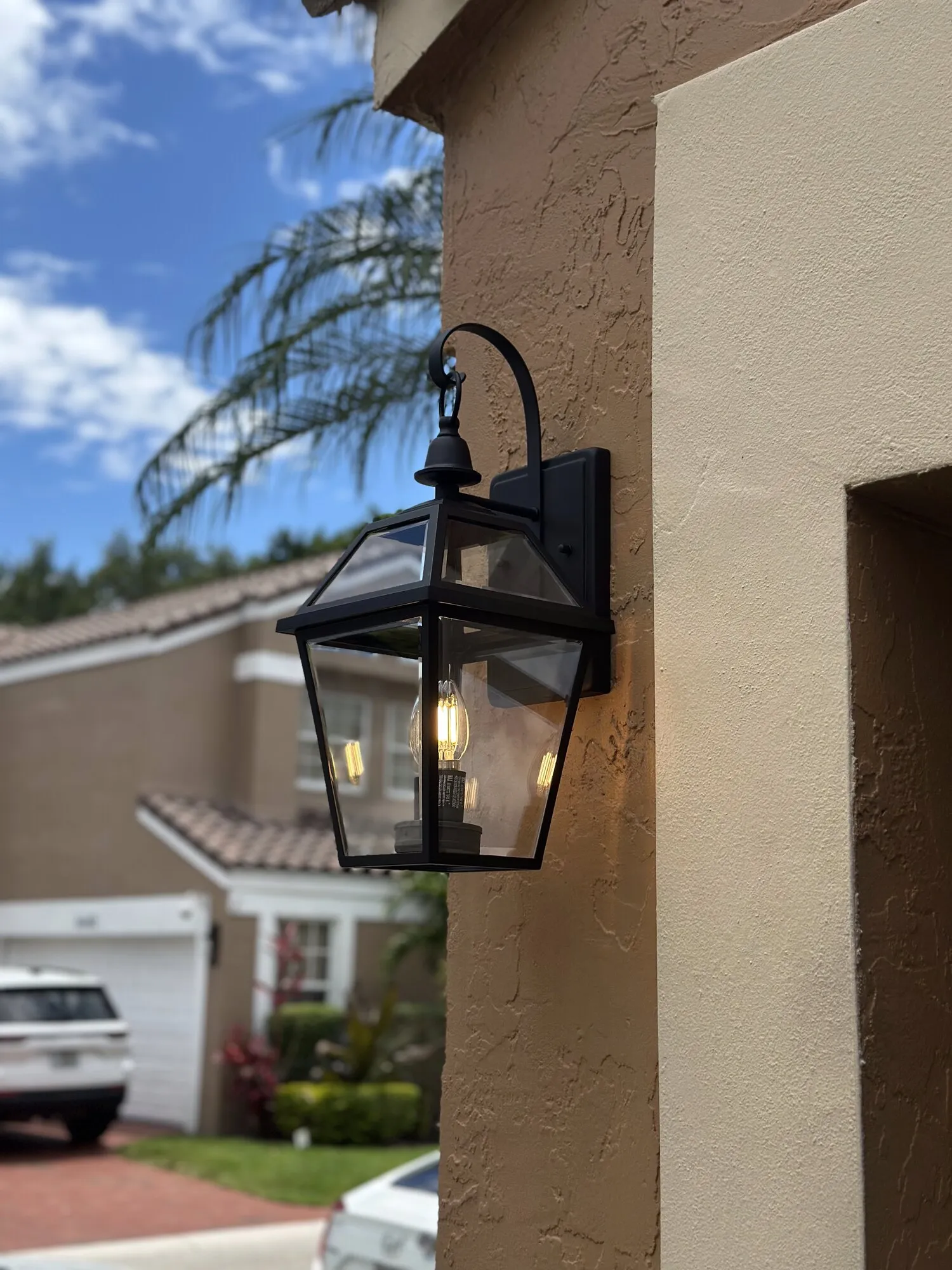
- Exterior light fixtures, especially wall lanterns and post lights. Check the mounting screws and the gasket where the fixture meets the wall.
- Handrails and stair rails set into concrete. Look for rust staining, which means the embedded steel is corroding and expanding.
- House numbers, mailboxes, hose reels, shutters on decorative brackets, satellite dish mounts.
- Screen enclosure and pool cage fasteners.
- Anything on a fence: gate hardware, latches, hinges.
Stainless hardware near the coast still corrodes. Replace anything showing rust with a marine-grade equivalent, and use a barrier or an isolating washer where stainless meets aluminum.
The timeline at a glance
| When | What | Why then |
|---|---|---|
| April – May | Service shutters and tracks, test panels and studs, inspect garage door label, repair soffit and fascia, trim trees, clear gutters, replace corroded exterior fasteners | Hardware problems take days to fix, and suppliers are calm |
| June 1 | Season opens. Prep should already be done | Nothing to do but keep supplies topped up |
| 5 days out | Watch the forecast, confirm your evacuation zone with the county, top up fuel and prescriptions | Zones and forecasts change; stores are still stocked |
| 72 hours out | Bring in loose yard items, charge everything, fill the car, do a dry run of one shutter | Last comfortable window to catch a problem |
| 36–48 hours out | Close shutters or install panels, brace the garage door, take down hanging plants and umbrellas | Ladder work in rising wind is the risk you are avoiding |
| 24 hours out | Fill the tub, set the fridge cold, park away from trees, stay off ladders | Conditions deteriorate faster than forecast |
| After | Photograph damage before touching anything, check for water intrusion, inspect roofline and soffit from the ground | Documentation first, repairs second |
What to have on hand
- Dry PTFE or silicone spray lubricant
- Stainless replacement wing nuts, washers and shutter studs to match your system
- A cordless impact driver and the correct bit for your panel hardware
- Tap and die set or thread chaser for the shutter studs
- Marine-grade stainless screws in the sizes your exterior fixtures use
- Wire brush, vacuum with a crevice tool, rags
- Paint marker for labeling panels
- Work gloves — aluminum panel edges cut
- A stable ladder and, ideally, a second person
72 hours out
- Do a dry run of one shutter or one panel. If it is fine, the rest probably are. If it is not, you have time to sort it.
- Clear the yard. Patio furniture, planters, grills, garbage cans, hose reels, kids’ toys, doormats, wind chimes. If you can lift it, wind can throw it.
- Take down anything hanging — plants, umbrellas, string lights, shade sails. Shade sails in particular are enormous sails, which is the entire problem.
- Charge everything and fill the fuel cans. Fuel lines get long and gas stations lose power.
- Photograph the house inside and out. Every room, every elevation. Time-stamped photos before a storm make insurance conversations shorter afterward.
- Confirm your evacuation zone with the county, not with memory. Broward County and Palm Beach County each run their own emergency management office with an address lookup. That is the only source worth using.
The last day
Shutters go up while it is still calm. Everything after that is indoor work: fill the bathtub for flushing water, turn the refrigerator to its coldest setting, move valuables off the floor and away from windows, and put important documents in something waterproof.
Then stop. No more ladders, no more roof, no more last-minute anything.
Safety and when to stop
Working aloft in wind is where people get hurt, and rising wind is not obvious until a gust catches a panel you are holding. Panels act like wings. If the wind is picking up and you still have openings to cover, cover the ones you can reach safely from the ground and leave the rest.
Do not go on the roof before a storm. Do not go on the roof after one either — wet tile is lethal, and storm-damaged decking can be soft in places that look fine. Assess from the ground with binoculars or a phone camera.
Treat every downed line as live. Stay away from standing water near any electrical equipment, and if water has reached outlets, the panel or the air handler, keep the power off until an electrician has looked at it.
Generators go outside, well away from the house, never in a garage even with the door open. Carbon monoxide is the part of storm recovery that kills people who did everything else right.
After the storm
Photograph first. Then walk the perimeter and look for the small stuff that turns into big stuff: lifted soffit panels, a fascia board pulled loose, torn screen, a gutter hanging off, water staining on ceilings, a shutter that will not retract because something bent.
Water intrusion is the real enemy in this climate. Anything wet that stays wet grows mold quickly in South Florida heat. Dry it out fast with fans and dehumidifiers, get wet drywall and soaked insulation out, and understand that actual mold remediation is a licensed specialty — not a bleach-and-hope job.
Roof damage, structural damage and anything involving your electrical service all need licensed trades. So does re-hanging a garage door that came off its track.
When it’s worth calling someone
The spring service list is the part most people never get to, and it is exactly the work that makes storm day boring instead of frantic. Handy Daddy handles shutter servicing, soffit and fascia repairs, exterior fixture replacement and the general home repairs that pile up before a season across Broward, Palm Beach and north Miami-Dade. If you are in a building rather than a house, condo drilling rules in South Florida covers what your association controls, and if you are weighing what to take on yourself, DIY or hire a handyman is an honest breakdown. For pricing questions, what a handyman costs in South Florida explains how the number gets built.
Questions people ask about this
When is hurricane season in South Florida?
The Atlantic hurricane season runs June 1 through November 30 every year. That is the window the National Hurricane Center monitors, and it is the date your prep should be finished by, not the date you should start. Storms can and do form outside those dates, but the season is the planning boundary that matters.
When should I service my hurricane shutters?
April or May, before the season opens on June 1. Tracks, wheels and bolts seize up over a year of humidity and salt air, and the time to find that out is on a quiet Saturday, not the afternoon a watch is issued. Run every shutter through its full travel and put a wrench on every panel bolt.
Do I need to brace my garage door for a hurricane?
Only with a bracing system approved for your specific door, and only if your door is not already rated for the wind loads where you live. A garage door is usually the largest opening in the house, and if it fails the wind gets inside and pushes up on the roof from below. Check the label on the door and talk to a garage door company if there is no rating on it.
How do I find out which evacuation zone I am in?
Use your county's official emergency management website or call them directly. Broward County and Palm Beach County each publish their own evacuation zone lookup by address, and the zones are revised from time to time. Do not rely on what a neighbor told you or on a map you saved five years ago.
What should a handyman look at before hurricane season?
Shutter hardware, garage door bracing hardware, loose fascia and soffit panels, exterior light fixtures and railings, gutters and downspouts, and anything screwed to the outside of the house that has been sitting in salt air. Those are all wind-catchers or water paths, and all of them are cheap to fix in May and expensive to fix in September.
Is it safe to put up shutters the day a storm is forecast?
It is far better than not putting them up, but it is the worst time to discover a seized track or a missing bolt. Panels are heavy, ladders are involved, and you will be working in heat and rising wind. Do the servicing months ahead so the day-of job is nothing more than lifting panels into working hardware.