Lighting & Electrical
Smart switch with no neutral wire: your four options
No neutral in the switch box? Here is how to identify a switch loop and the four real ways to get a smart switch working in an older Florida home.
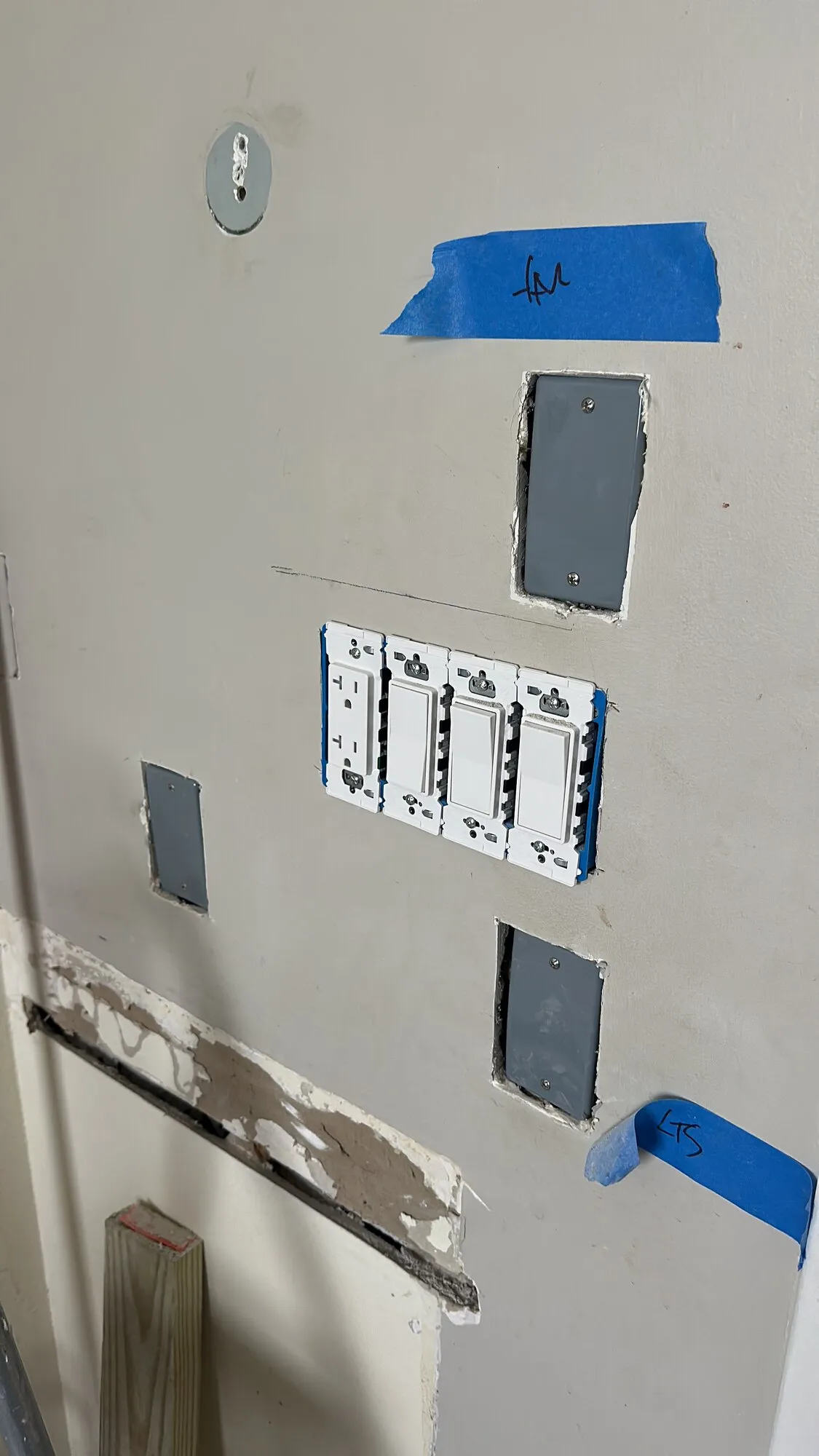
You bought a smart switch, opened the box on the wall, and there is no white bundle in there. Just a black wire, a white wire on the other screw, and a ground. The instructions want a neutral and you do not have one.
This is not a mistake and it is not unusual. It is how a huge number of South Florida homes were wired, and there are four real ways forward. Three of them do not involve opening a wall.
First, understand what you are looking at
Power has to get to a light. There are two common ways to do it.
Power at the fixture, switch loop down to the wall. The cable from the panel arrives at the ceiling box. The neutral terminates there at the fixture. A two-wire cable then runs down to the switch box carrying the hot, and comes back up carrying the switched hot. The switch is just a gate on the hot leg. No neutral ever reaches the switch box.
Power at the switch, feed up to the fixture. The cable from the panel arrives at the switch box first. The hot lands on the switch, the switched hot heads up to the light, and the neutral passes through the switch box on its way up. That neutral is available.
The first arrangement is a switch loop, and it is the reason you are reading this. It uses less wire, which is why it was popular. The National Electrical Code has required a grounded conductor at most switch locations since the 2011 edition, which is why new work almost always has one and 1970s and 1980s Florida houses frequently do not.
How to identify a switch loop in your box
- Turn off the wall switch, then turn off the breaker feeding it. Put tape on the handle.
- Verify the circuit is dead with a contact meter, not just a non-contact pen. Test between the conductors, and test your meter on a known-live circuit before and after. The full method is in how to replace a light fixture.
- Remove the cover plate and the two switch mounting screws, and pull the switch straight out of the box without disconnecting anything yet.
- Count the cables entering the box. Not wires. Cables.
- Look for a bundle of white conductors joined with a wire connector and pushed to the back of the box.
Now read it:
- One cable, two insulated conductors plus a ground: switch loop. No neutral. Often the white conductor is doing duty as the switched hot, and in correct modern practice it should be re-identified with black or red tape at both ends. In older work nobody bothered, which is exactly why you check with a meter rather than by color.
- Two or more cables, whites bundled and capped together: you have a neutral. Wire your smart switch to that bundle with a pigtail.
- Three-way switch, travelers involved: more complicated. There may or may not be a neutral, and smart three-way setups have their own rules. Photograph everything before you touch it.
- Conduit with individual conductors: common in some Florida construction. A white in the conduit may well be a neutral, but conduit runs get reused in odd ways. Verify.
Take photographs before you disconnect anything. Two shots, wide and close.
The one thing you must never do
Do not use the equipment grounding conductor as a neutral. Ever. Not “just for the little bit of current the switch needs.”
The ground is a safety path that carries no current in normal operation. Its whole purpose is to be at zero volts so that a fault has somewhere to go and the breaker trips. Put working current on it and every grounded metal box, every fixture canopy, and every appliance chassis on that circuit becomes part of a live return path. If that ground connection ever loosens, those surfaces go to line voltage.
There are smart switch installation videos that do this. They are wrong and they are dangerous.
Your four options
| Option | Wiring work | Cost | Best for | Main drawback |
|---|---|---|---|---|
| No-neutral smart switch | Swap the switch | Low to moderate | One or two switches, standard fixtures | Minimum load rules, may need a bypass module |
| Smart bulbs | None | Low per bulb, high per room | Lamps, small fixtures, renters, condos | Wall switch must stay on |
| In-fixture relay module | Work at the fixture, not the wall | Moderate | Keeping an existing switch and fixture look | Needs space in the canopy or ceiling box |
| Run a neutral | New wiring, licensed electrician | Highest | Whole-house retrofits, walls already open | Licensed work and permit in Florida |
Option 1: A no-neutral-capable smart switch
Some manufacturers build smart switches specifically for two-wire installations. Instead of drawing power from a neutral, they pass a very small current through the connected load to run their own radio and processor.
That trick has consequences:
- Minimum load. The switch needs enough wattage connected to keep its trickle stable. Manufacturers publish a minimum, and it varies enough that you must read the one on the box you are buying. Three efficient LED bulbs can fall below it.
- Ghosting. That trickle current can make efficient LEDs glow faintly when the switch is off, or blink.
- Bypass module. The usual cure is a small capacitor module wired across the fixture’s hot and neutral at the ceiling box. It gives the trickle somewhere to go. It fixes ghosting and it lets you go under the minimum load, but it means work at the fixture as well as the switch, so factor that in.
This is the neatest solution when it works. You keep normal wall control, the fixture is untouched, and anybody in the house can operate the light the way they always have.
Option 2: Smart bulbs
Leave the wiring alone. Put the intelligence in the bulbs.
Strengths: zero electrical work, color and tunable white if you want it, per-bulb control, and it moves with you when you leave. For renters and for condo owners dealing with association rules about anything touching building systems, this is often the only sensible route.
Weaknesses: the wall switch has to stay energized. Somebody flips it off and your automation is dead until they flip it back. The usual fixes are a switch guard, or a battery-powered smart button that sticks magnetically over the existing switch plate and sends commands wirelessly. Both work fine and both look like what they are.
Cost is the other consideration. Four smart bulbs in a fixture cost more than one smart switch, and every one of them is a device that can fail.
Option 3: An in-fixture relay module
A relay or micro module is a small controllable switch that fits inside the ceiling box or the fixture canopy, where the neutral already is. Your existing dumb wall switch becomes an input to it rather than the thing carrying the load.
Good for: keeping the original switch, keeping period-correct hardware, or covering several switches from one location. Also good where the switch box is a shallow single-gang with no room for a bulky smart switch behind it, which is common in older Florida block construction where boxes were set tight in a furred-out wall.
Watch out for: space. You need room in the canopy or box after the module goes in, and box fill is a real limit, not a suggestion. If the wires will not fold in without force, that is a no.
Option 4: Have an electrician run a neutral
Sometimes this is genuinely the right answer. If you are renovating, if the ceiling is open, if you want twenty switches converted, or if the run is short and accessible, pulling a proper neutral gives you a normal switch box that will accept any device for the next forty years.
In Florida this is licensed electrical work. New conductors, new cable runs, and anything at the panel require a licensed electrical contractor, and most municipalities in Broward, Palm Beach and north Miami-Dade will want a permit. I do not do it and I will tell you so.
Be realistic about the physical job too. South Florida homes are largely concrete block with furring strips and drywall over the block. There is often no open stud cavity to fish through, and the wall may be solid masonry behind the drywall. That turns a simple wire pull into surface raceway or cut-and-patch work. It is very achievable, but it is not the thirty-minute job people imagine.
Tools and materials
- Non-contact voltage tester and a contact multimeter
- Insulated screwdrivers, flat and Phillips
- Wire strippers
- Wire connectors sized for the conductor count
- Black or red electrical tape for re-identifying a white conductor used as a hot
- Your phone for photographs
- A no-neutral smart switch, bypass module, relay module or smart bulbs, depending on which route you chose
Safety and when to stop
Switch boxes look harmless. They are not, and the things that hurt people are boring rather than dramatic.
Turn off the breaker, not just the switch. In a switch loop, the conductor coming down from the ceiling is live even with the switch off.
Stop and call a licensed electrical contractor if:
- Two cables in the box come from different circuits, which can mean a shared neutral
- You find aluminum branch-circuit conductors, dull silver in color
- Insulation is cracked, cloth-covered, or crumbles when flexed
- There is scorching, melting, or a burned smell
- The box is metal and has no grounding path at all
- The box is already full and your device will not fit without forcing conductors
Box fill deserves a word. Smart switches are deep. Adding one to a shallow box that is already crowded can leave you compressing conductors against the device body, which damages insulation and traps heat. If it does not go in with a gentle push, do not push harder.
Getting the rest of the lighting right
Once the switch works, the other half of the job is the bulbs. If you are pairing a smart dimmer with LEDs, the compatibility rules matter and they are covered in the LED dimmer flicker fix. If the smart switch project came out of a fixture upgrade, how to replace a light fixture covers the box ratings and the surprise-wiring problems you may hit at the ceiling end.
When it’s worth calling someone
The identification step is where people get stuck: is this a switch loop or is there a neutral buried at the back of the box? That is a fifteen minute answer for someone who has opened a thousand of them. I do switch and outlet work across Broward, Palm Beach and north Miami-Dade, including no-neutral smart switch installs and bypass modules at the fixture. Running a new neutral is licensed electrical work and belongs with a licensed electrical contractor, and I will point you at one rather than pretend otherwise.
Questions people ask about this
How do I know if my switch box has a neutral wire?
Turn off the breaker, pull the switch out, and count the cables entering the box. One two-wire cable with a black, a white and a ground almost always means a switch loop with no neutral. Two or more cables with a bundle of white wires connected together and pushed to the back means you have a neutral available. Never assume based on the switch alone.
Can I use the ground wire as a neutral for a smart switch?
No. Never. The equipment grounding conductor is a safety path that normally carries no current, and using it as a return path energizes every grounded metal surface on that circuit during normal operation. It is a serious shock hazard, it defeats your breaker's fault path, and it is a code violation. If you have no neutral, use one of the no-neutral options instead.
Why do older homes have no neutral at the light switch?
Because power was run to the ceiling fixture first, and a two-wire cable dropped down to the switch and back. That is called a switch loop, and it only carries the hot down and the switched hot back up, so the neutral stays at the fixture. The National Electrical Code has required a grounded conductor at most switch locations since the 2011 edition, so homes wired before then often do not have one.
Do no-neutral smart switches actually work?
Yes, with caveats. They power themselves by passing a trickle of current through the connected bulbs, so they need a minimum load and can make efficient LED bulbs glow faintly when off. Many need a bypass module wired at the fixture to fix that. Check the manufacturer's minimum load figure against the total wattage of your bulbs before buying.
Are smart bulbs a better option than a smart switch?
For a single fixture with a handful of bulbs, often yes. Smart bulbs need no wiring work at all and give you color and per-bulb control. The downside is that the wall switch has to stay on for them to work, which is a real problem in a household where people flip switches out of habit. A magnetic remote stuck over the switch plate solves most of it.
Can a handyman run a neutral wire to my switch box in Florida?
No. Running new conductors is new electrical wiring, and in Florida that is work for a licensed electrical contractor, usually with a permit from your local building department. A handyman can swap a switch on existing wiring. Pulling a new neutral through a wall is a different job with a different license behind it.