TV & Mounting
How to hide TV wires without breaking the rules
How to hide TV wires safely: recessed power kits, why a TV power cord cannot go in a wall, CL2 and CL3 in-wall cable, fishing techniques and raceways for block walls.
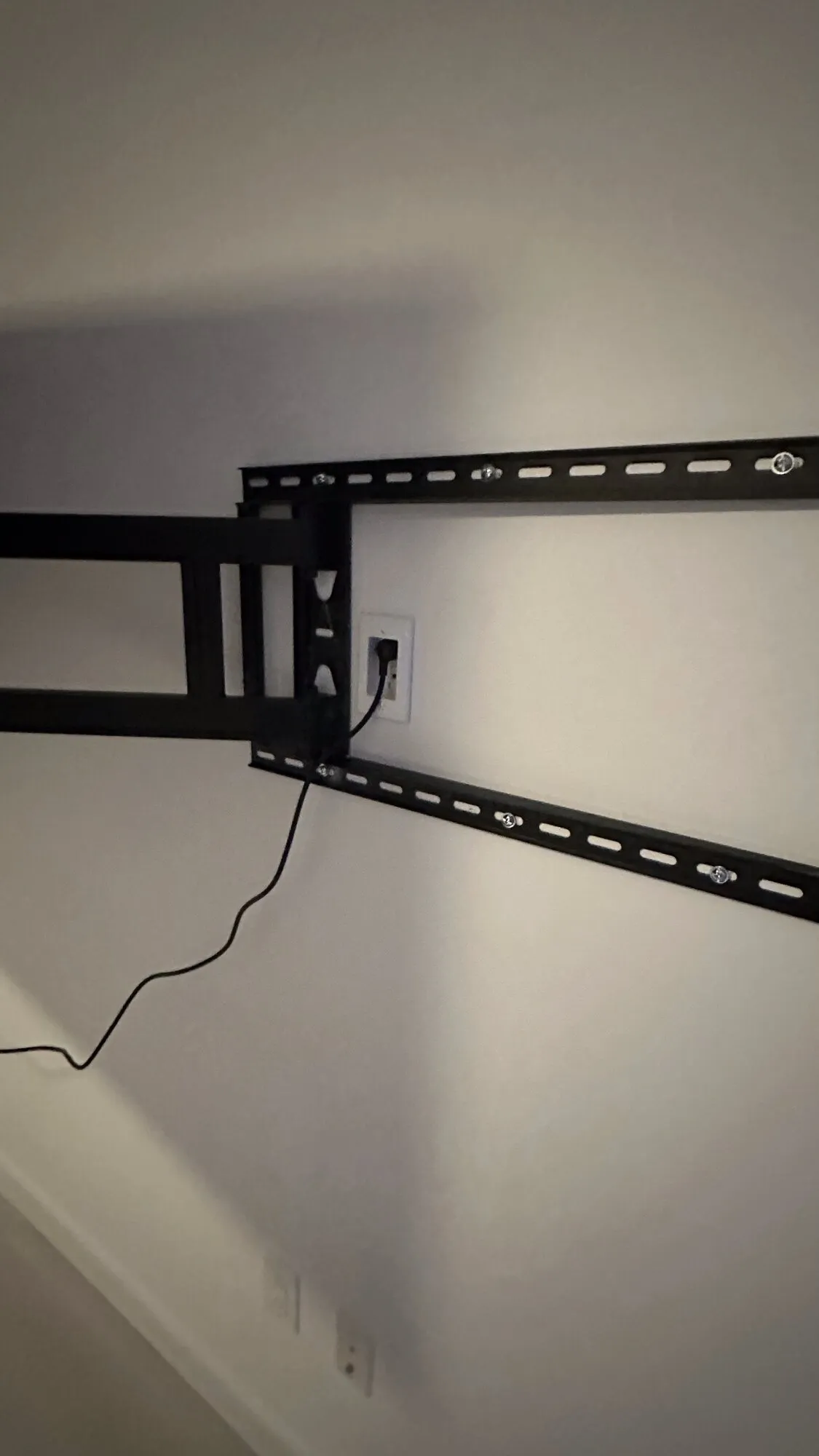
A perfectly mounted TV with six black cables hanging under it looks worse than a crooked TV on a bare wall. Hiding the wires is what makes the install look finished, and it is also the part where people do something genuinely unsafe because a YouTube video made it look easy.
Here is the honest version: there are three good ways to hide TV wires, one of them is off the table entirely, and which one you get depends on what your wall is made of.
The one thing you must not do
Do not push the TV’s power cord through a hole in the wall and out at the outlet below.
Two separate problems with it. First, that cord is a flexible cord, and the National Electrical Code is explicit that flexible cord may not be used as a substitute for the fixed wiring of a building, nor run through holes in walls, ceilings or floors — that is Article 400, in the “uses not permitted” section. Second, the reason for the rule: a TV cord’s jacket has no in-wall fire rating. Cable that lives inside a wall cavity has to resist flame spread, because a wall cavity is a chimney. A lamp cord in a stud bay is not.
It also voids the TV manufacturer’s terms in most cases, and an inspector or an insurance adjuster who sees it after a fire will notice.
The workaround people suggest — cut a hole, push the cord through, plug it in below — takes the same amount of effort as doing it correctly. So do it correctly.
Option 1: Recessed power kit (framed walls)
This is the proper solution and it is not expensive.
A recessed power kit is a listed assembly: two shallow in-wall boxes joined by a length of cable that is rated for in-wall use. The upper box contains a receptacle and gets cut in behind the TV. The lower box contains a power inlet and gets cut in near your existing wall outlet. A short cord runs from the existing outlet into the inlet.
The result is a receptacle behind your TV, everything inside the wall is rated for being inside a wall, and you have added no new circuit and touched no permanent wiring. Look for a kit that is UL listed and sold specifically for this purpose.
Some kits are designed to be hard-wired at the lower end instead of plugging in. That version means opening up an existing circuit, which in Florida is licensed electrician work. Buy the plug-in version unless you are hiring an electrician anyway.
Load note: these kits are rated for TV-scale loads, not a space heater or a window unit. Read the rating on the box and do not treat the new outlet as a general-purpose receptacle.
Option 2: In-wall rated signal cable
Your HDMI, optical, ethernet, coax and speaker runs go in a separate hole from the power kit, because the code that governs Class 2 and Class 3 circuits does not allow low-voltage cable to share an enclosure or raceway with power conductors, except under specific conditions. Practically: two openings, spaced apart, one for each.
Buy cable printed with the right rating:
| Marking | Means | Use it for |
|---|---|---|
| CL2 | Class 2, in-wall fire rated, 150 V | Most residential HDMI and speaker runs inside a wall |
| CL3 | Class 3, in-wall fire rated, 300 V | Same jobs, higher voltage rating, common on longer speaker runs |
| CMR | Riser rated | Vertical runs between floors |
| CMP | Plenum rated | Runs through an air-handling plenum space |
| No rating | Patch cable | Behind the console, outside the wall, nowhere else |
Two practical points. Run one spare of everything — pulling a second HDMI later means opening the wall again, and cable is cheaper than drywall repair. And for long HDMI runs, or anything over about 25 feet, check whether the cable is certified for the resolution and refresh rate you actually want, because passive HDMI gets unreliable with length.
At each end, use a low-voltage mounting bracket (an old-work “mud ring”) rather than a full electrical box. It is an open frame that clamps to the drywall and gives you something to screw a wall plate to, without boxing in the cable. Finish with a brush plate — a wall plate with a bristle opening — so the cable passes through and the hole still looks intentional.
Option 3: Raceway or cord cover (block walls, and anyone who rents)
If your wall is concrete block, there is no cavity to fish. Behind the drywall is a 3/4 inch furring gap and then solid masonry. A flat HDMI cable can sometimes be persuaded into that gap, but a recessed power box needs roughly 2-1/2 to 3 inches of depth and simply will not fit. Cutting a channel into block for cable is a demolition job with a grinder, and no.
The answer on block is a paintable surface raceway. A slim PVC channel that sticks or screws to the wall, takes a coat of the room’s wall paint, and stops being visible from about six feet away. Buy the version with a decent radius on the corners and a proper base-and-cover design rather than a soft plastic sleeve.
- On block, fix the raceway with 3/16 inch concrete screws rather than trusting adhesive alone, especially in a humid room
- Keep the line-voltage cord and the signal cables in separate channels, or separate raceways, and follow the raceway product’s own listing for what it may carry
- Paint the raceway before you fit it, on a drop cloth, and touch up the fastener heads afterward
- A cable sleeve or fabric wrap is the renter-friendly, zero-holes version. It bundles rather than hides, but it turns six cables into one and that is most of the visual win
More on the realities of block construction is in mounting a TV on a concrete block wall.
Fishing cable in a framed wall
- Find the cavity and confirm it is clear. Use a stud finder to establish both stud edges, then drill a small test hole and probe with a bent wire. You are looking for insulation, fire blocking, ductwork, plumbing or existing wiring.
- Locate both openings in the same stud bay. This sounds obvious and is the most common failure. Measure from the same reference point at both heights.
- Stay at least 6 inches to the side of the existing outlet box. Cable runs to a box rarely arrive straight from below.
- Cut the upper opening first, using the low-voltage bracket as your template. Score the outline with a utility knife before cutting so the paper face does not tear.
- Drop a chain or a magnetic pull from the top opening and retrieve it at the bottom with a magnet or a bent hanger. A fiberglass fish rod is easier if you own one, and the magnet system is easier if you do not.
- Tape your cables to the pull line in a smooth taper — narrow nose, tape wrapped in the direction of travel, no lumps. A fat, blunt bundle catches on everything.
- Pull steadily. If it stops, do not yank. Something is in the way and yanking is how you strip an HDMI connector or damage an existing cable.
- Leave a service loop at both ends: about 12 to 18 inches of slack, more if the mount is full-motion. An articulating arm at full extension will pull an HDMI straight out of a tight cable every time.
- Seal the penetrations you made through top plates or fire blocking with fire-rated caulk. That barrier exists for a reason.
What stops a fish
- Fire blocking. Short horizontal members inside the cavity, common at mid-height in tall walls and always at floor and ceiling lines. If you hit one, you need a second access opening at that level.
- Insulation. Exterior walls are packed with it. A rod pushes through, a chain does not.
- A horizontal brace or a header over a window or door.
- The wall not being a cavity at all. Which brings us back to block.
Behind the TV: cable management that actually stays tidy
- Bundle with hook-and-loop wrap, not zip ties. You will be adding a device within a year and you will be glad.
- Route the power cord down one side and signal cables down the other, so they are not woven together behind the panel.
- Mount power strips and streaming boxes to the back of the mount plate or on a small shelf, not resting on the mount arms where they rattle.
- On a full-motion mount, swing the arm through its full range before you tighten anything and watch where the cables want to go. Then set the slack for the extended position, not the flat one.
- If the TV sits above a floating console, drill one 2 inch grommet hole in the console top and let everything drop through. This is the single highest-value five minutes of the job.
Safety and when to stop
- Anything inside a wall that is not yours to touch. If your hole saw exposes wiring, plumbing, or a cable you cannot identify, stop, do not cut further, and get eyes on it.
- Aluminum wiring, cloth-insulated wiring, or a panel with obvious problems. Some older South Florida homes have surprises. Close it up and call a licensed electrician.
- New circuits, hard-wiring, or moving a receptacle. That is licensed electrical work in Florida. A plug-in recessed kit is not; adding a new outlet is.
- Exterior block walls. Do not chase channels into the face shell to hide cable. Small anchor holes are one thing, cutting into the shell is another.
- Condo and HOA rules. Many buildings restrict cutting into walls at all, particularly demising walls between units. Check first: condo drilling rules in South Florida.
Quick decision guide
| Your wall | Power | Signal cable |
|---|---|---|
| Wood or metal stud, open cavity | Listed recessed power kit | CL2/CL3 fished in the cavity, low-voltage brackets each end |
| Concrete block with furring | Paintable raceway or cord cover | Flat cable in the furring gap if it fits, otherwise the same raceway in a separate channel |
| Rental, no holes allowed | Cord cover or cable sleeve | Same |
| Above a fireplace | Depends entirely on the chase — see below | Same |
Above a fireplace the run is often blocked by the flue, the firebox or a solid masonry chase, and there is frequently no receptacle up there at all. That job has its own set of problems, covered in mounting a TV above a fireplace.
When it’s worth calling someone
Fishing cable is easy right up until the moment it isn’t, and the difference between a clean job and a wall full of exploratory holes is knowing what is in the cavity before you cut. If you want the cables gone without owning that risk, I do TV mounting and cable concealment across Broward, Palm Beach and north Miami-Dade, including the block walls where the honest answer is a well-painted raceway. The rest of the install is covered in how to mount a TV on the wall.
Questions people ask about this
Can I run a TV power cord inside the wall?
No. A TV's factory power cord is a flexible cord, and the National Electrical Code does not permit flexible cord to be used as a substitute for fixed wiring or to be run through holes in walls. The cord's jacket also has no in-wall fire rating. The correct solution is a listed recessed power kit, which relocates a receptacle behind the TV using cable that is rated for the wall.
What is a recessed power kit and how does it work?
It is a listed pair of in-wall boxes joined by in-wall rated cable. The upper box holds a receptacle that sits behind the TV; the lower box holds an inlet that you plug into your existing outlet with a short cord. No new circuit, no splicing, and every part of the run inside the wall is rated for it.
What does CL2 or CL3 rated cable mean?
CL2 and CL3 are fire-resistance ratings from Article 725 of the National Electrical Code for Class 2 and Class 3 circuits, which covers HDMI, speaker wire and similar low-voltage runs inside walls. CL3 carries a higher voltage rating than CL2. Buy HDMI and speaker cable printed with CL2 or CL3 if it is going in a wall, and CMP-rated cable if it passes through a plenum.
How do I hide TV wires on a concrete block wall?
Use a paintable surface raceway. Block walls have no cavity to fish through — only a 3/4 inch furring gap behind the drywall, which is too shallow for a recessed power box. A slim raceway painted to match the wall disappears from a few feet away and takes an hour, versus cutting a channel into masonry.
How far should the cable hole be from the wall outlet?
At least 6 inches to the side. Wiring rarely runs in a straight vertical line above a box, and you do not want a hole saw finding a cable. Keeping low-voltage cable separated from power conductors is also required by code, so signal and power get their own openings, not a shared one.
Do I need an electrician to hide TV cables?
Not for a plug-and-play recessed power kit or a raceway, which involve no new wiring. You do need a licensed electrician if you want a new receptacle added behind the TV on its own circuit, if a kit calls for hard-wiring, or if you find anything unexpected inside the wall.